
BSE needs to shift focus from trading to capital raisin

Equity benchmark indices rallied nearly 1 per cent to re-visit the 59,000-mark on Monday, tracking heavy buying in index heavyweights Reliance Industries and ICICI Bank. The BSE benchmark rose 442.65 points or 0.75 per cent to settle at 59,245.98. During the day, it jumped 504.92 points or 0.85 per cent to 59,308.25.

Investors' wealth jumped Rs 2,93,054.25 crore on Thursday as markets returned to winning ways after falling for three straight sessions. The 30-share BSE benchmark Sensex zoomed 638.70 points or 1.22 per cent to close at 52,837.21. During the day, it gained 668.75 points to 52,867.26. Tracking the bullish trend, the market capitalisation of BSE-listed companies jumped Rs 2,93,054.25 crore to reach Rs 2,33,94,917.25 crore.

Investor wealth on Friday declined over Rs 2.23 lakh crore as markets cracked. The 30-share BSE Sensex slumped 549.49 points or 1.11 per cent to close at 49,034.67. During the day, it plunged 788.37 points to 48,795.79.

Benchmark indices fell on Monday with the BSE Sensex declining 306 points, mainly dragged down by Reliance Industries. Foreign funds outflow also added to the overall bearish trend in equities on Monday. The 30-share BSE benchmark fell 306.01 points or 0.55 per cent to settle at 55,766.22. During the day, it declined 535.15 points or 0.95 per cent to 55,537.08. The broader NSE Nifty dipped 88.45 points or 0.53 per cent to 16,631.

Equity indices nursed losses for the second consecutive session on Tuesday as investors continued to dump IT, banking and FMCG stocks amid a bearish trend in global markets. Unabated foreign fund outflows and the rupee dropping to another record low against the US dollar added to the woes, traders said. Participants were also in wait-and watch mode ahead of release of retail inflation and factory output data.

From the Sensex pack, Tata Motors, Sun Pharma, Wipro, Tata Consultancy Services, UltraTech Cement, Tech Mahindra, Bajaj Finserv, HCL Technologies, Infosys and IndusInd Bank were the major laggards. NTPC, Power Grid, Reliance Industries, Tata Steel, HDFC and HDFC Bank were the major winners.
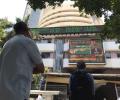
Investor wealth slumped by Rs 3.7 lakh crore on Monday, as the equity market recorded its biggest single-day fall in two months.

It is pouring heavily not only in North India, but at Dalal Street too. However, the latter is seeing a flurry of initial public offers (IPOs). After a busy fortnight that ended on July 7 with seven IPOs - IdeaForge Technology, Cyient DLM, PKH Ventures, Pentagon Rubber, Global Pet Industries, Tridhya Tech, and Synoptics Technologies -- four more IPOs will hit the Street this week, including one mainboard IPO of Utkarsh Small Finance Bank. That apart, India's largest securities' depository National Securities Depository Limited (NSDL) has filed its draft red herring prospectus (DRHP) with the Securities and Exchange Board of India (Sebi) for an IPO.
Capital goods, IT, auto and pharmaceuticals lead gains for the financial year

Markets at close: Sensex ends in green; Nifty rises to new closing peak.

The 30-share Sensex ended higher by 30 points.

Market benchmark BSE Sensex rallied 635 points to 59,942 in the opening trade of the special Muhurat session on Monday to mark the beginning of Hindu Samvat year 2079. The 30-share index was trading higher by 635.12 points, or 1.07 per cent, at 59,942.27 in the first few minutes of trade. Similarly, the broader NSE Nifty surged 192.20 points or 1.09 per cent to 17,768.50.

Among the Sensex firms, HCL Technologies fell the most by 2.4 per cent. IndusInd Bank (2.35 per cent), Infosys (2.28 per cent), Wipro (1.8 per cent), NTPC (1.71 per cent), Asian Paints (1.7 per cent), Tata Consultancy Services (1.36 per cent),Tech Mahindra (1.03 per cent) and SBI (1 per cent) were among the major laggards.

Amid current geopolitical challenges and a slowdown in global growth, veteran emerging market investor Mark Mobius called India a safe haven for investors, backed by a stable government. The renowned investor, who is excited about the opportunities available in India, said the country is now the second largest in the portfolio of Mobius Capital Partners after Taiwan. Calling India a "land of opportunities and innovation", he said that his optimism about India is driven by the stable government and young demographic, with an average age of 27 years.

Top losers in the Sensex pack on Friday included Bajaj Finance, ONGC, IndusInd Bank, PowerGrid, L&T, Axis Bank, NTPC, Bharti Airtel, HDFC, HDFC Bank and Kotak Mahindra Bank, falling up to 2.08 per cent.
Equity indices frittered away a good start to close with modest losses on Monday, pressured by heavy selling in metal stocks after the government imposed export duties on steel-making raw materials to curb soaring prices. The 30-share BSE Sensex opened strong and gained momentum as the session progressed, but came under severe selling pressure in afternoon trade to close 37.78 points or 0.07 per cent lower at 54,288.61. On similar lines, the broader NSE Nifty slipped 51.45 points or 0.32 per cent to end at 16,214.70.
Investors' wealth zoomed by Rs 5,78,634.72 crore in two days of intense market rally, with participants adding Rs 2,74,908.83 crore to their fortune on Tuesday. Over the past two sessions, the BSE gauge Sensex has gained about 1,461 points or 2.99 per cent. The benchmark rallied 612.60 points or 1.24 per cent to settle above the 50,000-mark on Tuesday. Following the two-day massive rallies, the market capitalisation of BSE-listed companies jumped by Rs 5,78,634.72 crore to a record Rs 2,16,39,367.91 crore on Tuesday.

Investors' wealth rose by Rs 2,22,763.25 crore in three days of market rally, with the benchmark Sensex closing at an all-time high on Thursday. At close of trade, the 30-share BSE index gained 254.80 points or 0.48 per cent to 53,158.85, its lifetime closing high. During the day, the benchmark also reached its all-time intra-day peak of 53,266.12 points. The benchmark has gained 786.16 points in three days.

A key demand is to reduce the dividend distribution tax on listed firms.

Tata Steel was the top gainer in the Sensex pack, zooming 7.57 per cent, followed by Sun Pharma, IndusInd Bank, L&T, ITC and HCL Tech.

Broader market outperformed the frontline indices and also hit their respective all-time highs

Public-sector enterprise stocks have seen a good run thus far in 2023-24 (FY24), with the S&P BSE PSU Index surging by over 26 per cent during the period, compared to an 11 per cent increase in the benchmark S&P BSE Sensex.

Sensex may remain under pressure this week due to weak global factors.
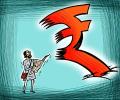
Equity investors became poorer by over Rs 8 lakh crore in five days of market plunge. The BSE benchmark has lost 2,062.99 points or 4 per cent in five trading sessions. On Thursday, the 30-share BSE benchmark tanked 585.10 points or 1.17 per cent to close at 49,216.52. Following the bearish trend, the market capitalisation of BSE-listed companies declined by Rs 804,216.71 crore to Rs 2,01,22,436.75 crore in five days.

L&T was the top loser in the Sensex pack, dropping 4.99 per cent, after the engineering major posted a 45 per cent decline in consolidated net profit for the September quarter. Titan, ONGC, Axis Bank, HUL, NTPC, M&M and HDFC were the other major laggards, shedding up to 3.32 per cent. NSE Nifty fell 58.80 points or 0.50 per cent to 11,670.80.

The S&P BSE Sensex has dipped five per cent, thus far, in CY15.
A rebounding and steady market is a good time to weed sectors and funds that tend to drag the portfolio.

All BSE sectoral indices ended in the red, with oil and gas, bankex, capital goods and finance falling up to 3.04 per cent.

Mixed earnings and not so encouraging macroeconomic data dented sentiment, Ajit Mishra, VP - Research, Religare Broking Ltd said. In twin blows to Indian economic revival, higher food prices drove retail inflation to a five-month high of 7.4 per cent, while factory output fell for the first time in 18 months. The second consecutive month of rise in consumer price index (CPI)-based inflation will add to the pressure on the Reserve Bank of India (RBI) to again raise interest rates to tame high prices. In the broader market, BSE Midcap declined 0.73 per cent while smallcap dropped 0.45 per cent.

Small stocks of Dalal Street grappled with turbulent times in 2022 as high volatility and higher interest rate regime sapped investors' appetite for these scrips but the horizon ahead seems less cloudy for the New Year. While the 30-share Sensex scaled multiple record peaks with bluechips glittering, small stocks underperformed and the BSE smallcap index declined more than 3 per cent this year. In comparison, the BSE Sensex climbed 2,673.61 points or 4.58 per cent till December 27.

The Indian markets have seen a good run in the last three months with the S&P BSE Sensex rising around 7 per cent and the Nifty50 moving up 7.5 per cent. The next leg of the market rally from here on, analysts suggest, will be driven by a growth in corporate earnings over the next few quarters. That said, they do not expect material / sharp downgrades to India Inc's earnings estimates despite headwinds for the economy.

Experts prefer domestic consumption-driven plays and defensives such as information technology and pharmaceuticals

The markets may be entering a consolidation phase and are expected to trade sideways for now after a good run in the last few weeks, suggest analysts. In this backdrop, they suggest investors can book profits at the current levels and enter the market again on a decline from a medium-to-long term perspective. Thus far in fiscal 2023-24 (FY24), the S&P BSE Sensex has moved up around 5 per cent to nearly 62,000 levels.

At an aggregate level, the late ace investor's portfolio that was valued at Rs 32,445 crore as on March 31, 2023 is now worth Rs 35,979 crore.

The breadth was neutral with 1,329 advances and 1,320 declines.
Shares of ICICI Bank may outperform those of HDFC Bank in the near-term, analysts said recently, after the Sandeep Bakhshi-led private sector lender reported a strong set of numbers for the July to September quarter (Q2) of financial year 2023-24 (FY24). The result, they said, reiterated that ICICI Bank is maintaining a sustainable and prudent growth led by tech-driven initiatives as against HDFC Bank, which is facing merger related challenges. According to analysts at Prabhudas Lilladher, ICICI Bank is valued at par with HDFC Bank at 2.2x/1.9x on FY25/26E core adjusted book value (ABV) basis.

the Sensex lost 23 points to close at 28,185 levels and the Nifty shed 7 points to end at 8,515 mark.

The move to demerge the hotel business into a separate entity by ITC has brought back focus on hotel stocks, which have already seen a good run thus far in fiscal 2023-24 (FY24). Analysts believe there could be more gains in store over the next one year for the stocks in this sector, but suggest investors put in money on a correction only from a long-term perspective. Hotel stocks, according to A K Prabhakar, head of research at IDBI Capital, have seen a good run as travel picked up post Covid in India. Not only have the room rents increased, the occupancy, too, has surged.

BSE is world's largest exchange in terms of listed companies and figures among top 10 globally on various other parameters.
 © 2026 Rediff.com - Advertise with us - Disclaimer - Privacy Policy - Sitemap - Feedback - About us - Terms of use - Grievances